
Korean Dates and Weekdays Are All Sino-Korean
Months, days and weekdays take 일, 이, 삼 (il, i, sam) — the opposite of clock hours. Why the calendar never switches to 하나, 둘, 셋.
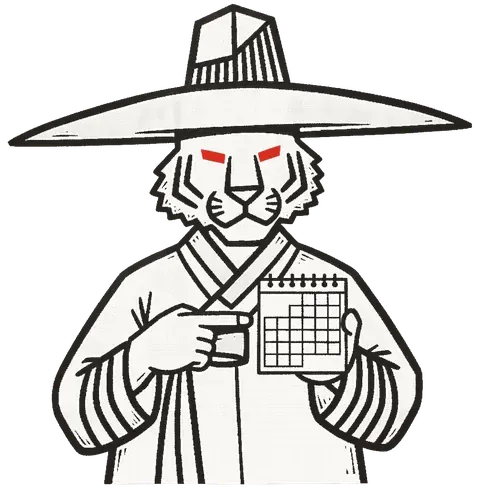
The calendar does not mix
Telling time mixes the two sets in one reading. The calendar does not mix. Month, day, and weekday are all Sino-Korean.
That is the opposite of 세 시. It looks unfair until you see what a date is doing. A clock hour counts a slot, the way 한 개, 두 마리 count things you can point at. A month name, a day of the month, and a weekday are labels on a written calendar. They came in with the Chinese characters for those labels, so they sit with 일, 이, 삼 — the same set as minutes and money. The two number systems are the root. The calendar just never switches back.
Month, day, weekday
Months: 일 월 through 십이 월, usually written 1월, 12월. Two readings are fixed: 유월 for June, 시월 for October. 육월 and 십월 are the forms learners invent from 육 and 십.
Days of the month: 일 일, 이 일, 삼 일 … 삼십일 일. Speech is Sino-Korean. Writing is often 3일, 15일.
Weekdays keep the same set, with 요일 attached: 월요일, 화요일, 수요일, 목요일, 금요일, 토요일, 일요일 (woryoil, hwayoil, suyoil, mogyoil, geumyoil, toyoil, iryoil). There is no 한요일.
In a sentence
오늘은 금요일이에요.
oneureun geumyoirieyo — Today is Friday.
오늘 refuses 에. 는 sets today against other days — 은/는 vs 이/가. 금요일이에요 is 이다 after a batchim, so -이에요.
월요일에 만나요.
woryoire mannayo — Let’s meet on Monday.
The weekday takes 에 the way a clock time does. Stack the two and 에 waits for the end: 월요일 세 시에. Native hour, Sino-Korean day. Each half keeps the set it had on its own page.
몇 월 며칠이에요? asks the date. 무슨 요일이에요? asks the weekday. 주말에 가요 is the weekend, and 주말 takes 에.
Years and the test
Years are Sino-Korean too: 이천이십육 년. Age in 살 stays native — 스무 살 — because 살 counts a person the way 개 counts an apple. The year label on a calendar does not.
If a sentence has a clock in it, listen for the switch at 시. If it has only a calendar, stay on Sino-Korean all the way through. Money and 만 stay on that same set — and 만 is not an English thousand.
Common questions
Why is the calendar the opposite of the clock?
Hours count slots the way [counters](/posts/korean-counters/) count objects, so they stay native. Months, days, and weekdays are named calendar units — written with 月, 日, and 月火水木金土日 — so they take the Sino-Korean set that also runs money and minutes.
Do I say 삼 월 or 3월?
Both are read 삼 월. Writing usually puts the Arabic numeral plus 월. Speech is Sino-Korean either way. Never 세 월.
How do I ask the date?
몇 월 며칠이에요? for the month and day. 무슨 요일이에요? for the weekday. 며칠 is the day-of-month question; 몇 일 is understood but 며칠 is the word people say.
Should I read the number pages first?
Yes. [The two sets](/posts/korean-two-number-systems/) and [telling time](/posts/korean-telling-time/) are the chain. This page is the calendar half of that split.
Practice & questions
Try a sentence with an expression from this lesson, or ask about anything you are still unsure of.
Guest comments appear after review. Existing member comments remain attached to their accounts.