
Korean Counters: 개, 명, 마리, 잔, 권 (Gae, Myeong, Mari, Jan, Gwon)
The word after the number tells you what you are counting. 개, 명, 마리, 잔, 권 — and why hana shortens to han before them.
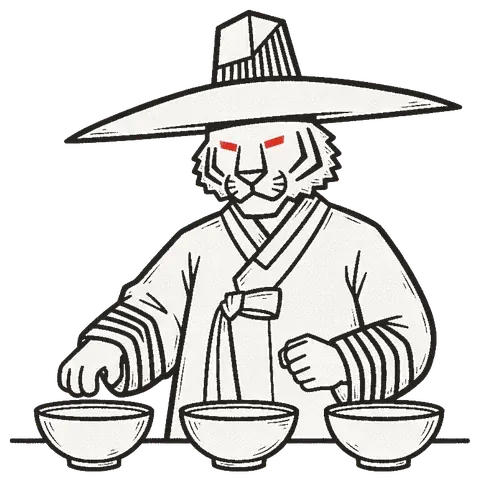
After the number
The two number systems come first. Counters are the word that sits after the number and names what you are counting. Korean does not say “three apples” as 셋 사과. It says 사과 세 개.
표준국어대사전 splits the common ones by use.
Five counters
개 is a dependent noun: the unit for objects that come as single pieces. Apples, tickets, chairs. 명 is the unit for people. 마리 is the unit for beasts, fish, and insects. 권 is the unit for books. 잔 is listed as the cup itself — a small vessel for tea or coffee, with a handle and a saucer. After a number it counts the drinks poured into that cup.
하나 shortens
사과 한 개 주세요.
sagwa han gae juseyo — One apple, please.
주세요 ends in -(으)세요. The number is not 하나. 하나, 둘, 셋, 넷 shorten to 한, 두, 세, 네 the moment a counter follows. 다섯 and up keep their shape: 다섯 개.
개가 두 마리 있어요.
gaega du mari isseoyo — There are two dogs.
개가 presents the dogs as news, so 이/가. The counter is 마리, not 개. Using 개 here would count the dogs as objects.
이 책은 세 권이에요.
i chaegeun se gwonieyo — These are three books.
권 takes the batchim-form copula: -이에요. 이다 again, attached to the counter phrase.
People take 명: 학생 네 명. Staff often raise that to 분 — 세 분 오세요 — but the unit is the same job.
The pattern and 몇
The pattern is noun, then native number, then counter. The number system does not change just because a counter appeared. Dates and minutes still want Sino-Korean; these five counters, in the everyday range, want the native set you already met.
A useful question is 몇: 몇 개 있어요?, 몇 명 오세요?, 몇 권 빌릴게요? 몇 stands where the number will go, and the counter stays. That is how you ask without guessing the count.
Clock time is where the two systems sit in one sentence — native hour, Sino-Korean minute. That is the next page. The counters on this page do not make that split. They keep the native set for objects, people, animals, cups, and books.
Common questions
If I forget the counter, can I just say 개?
For inanimate objects, yes — 개 is the general object counter. Do not use it for people or animals. 사람 세 개 and 고양이 세 개 both sound like you are stacking goods.
Is 분 the same as 명?
분 is the raised people counter. 세 분 오세요 is how staff count guests. 명 is the plain unit. Same job, different height.
Does 잔 mean the counter, or the cup?
The dictionary lists 잔 as the cup itself — a small vessel for tea or coffee. After a number it counts drinks poured into that cup: 커피 두 잔. It is not filed as a separate dependent noun the way 개 and 권 are.
Do I need the two number systems first?
Yes. Counters ride on native numbers in this range. [Start with the two sets.](/posts/korean-two-number-systems/) Sino-Korean digits belong on dates and minutes, not on 한 개.
Sources
Written as educational material for Korean learners. Sources for the facts are below:



Practice & questions
Try a sentence with an expression from this lesson, or ask about anything you are still unsure of.
Guest comments appear after review. Existing member comments remain attached to their accounts.