
Korean Money: 얼마예요 (Eolmayeyo) and How to Read 원 (Won)
Prices use Sino-Korean numbers, and 만 is ten thousand, not an English thousand. How to ask 얼마예요 and read a tag in 원.
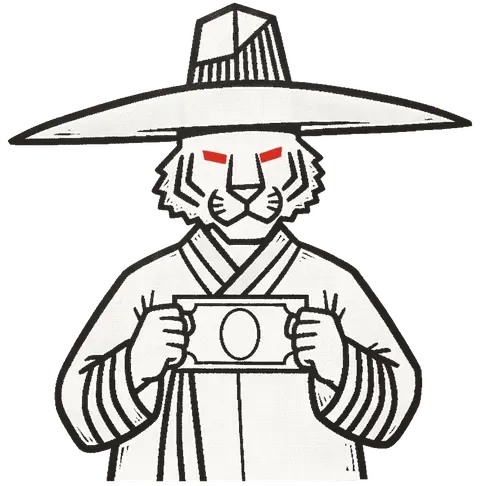
Asking the price
Dates stay on Sino-Korean all the way through. Money does too. Read the two number systems first — 일, 이, 삼 — because a price never switches to 하나, 둘, 셋.
이거 얼마예요?
igeo eolmayeyo? — How much is this?
얼마예요 is 이다 after a vowel. 이거 is the thing in your hand. If you are pointing something out as news, 이게 얼마예요 uses 이/가 on 이것, contracted to 이게.
원
표준국어대사전 lists 원 as a dependent noun: Korea’s currency unit, in force from 10 June 1962, one hundred 전. The tag you read is in 원.
The number in front of 원 is Sino-Korean, the same set as minutes and calendar days. 천 원 is 1,000. 오천 원 is 5,000. That part feels like English thousands.
만 is not a thousand
Then 만 arrives, and English stops helping. The dictionary lists 만 (萬) as a numeral: ten times 천, also called 일만. So 만 원 is 10,000 won, not 1,000. 만은 천의 열 배예요 — 은/는 vs 이/가 sets 만 as the topic against 천.
A tag that reads 15000 is 만 오천 원. Learners who think in thousands say 십오 천 원, as if Korean grouped the way English does. It does not. One 만, then the leftover 오천. A tag that reads 150000 is 십오만 원. The 만 block moved one place left.
You do not invent a native reading. 다섯 원 is not how a price is said. 오 원 is. The clock mixed the two sets inside one sentence. A price does not mix. Counters such as 개 stay off the tag: the unit is already 원.
After 만
억 is the next named block after 만 — one 억 is ten thousand 만. You will see it on news figures, not on a lunch tag. This page stops at the 만 hinge, because that is the place English thousands break.
카드로 할게요 is a paying line, not a reading line. This page is the number on the tag and the question that asks for it. After this, the two sets have somewhere to go besides a clock and a calendar.
Common questions
Is 원 the same as a dollar or a pound?
No. 원 is Korea's own unit. The dictionary lists it as the currency unit in force since 10 June 1962, one hundred 전. Everyday tags are in 원, not in 전.
Why can't I say 십오 천 원?
Korean groups large numbers by 만 (10,000), not by thousands. Fifteen thousand is 만 오천, one block of 만 plus the leftover 천. [The two number systems](/posts/korean-two-number-systems/) are Sino-Korean here — 일, 이, 삼 — never 하나, 둘, 셋.
Do I need counters for money?
원 itself is the unit. You do not add 개. 만 원이지 만 개 원이 아니에요. Object counters stay on [the counters page](/posts/korean-counters/).
얼마예요 or 얼마이에요?
얼마 ends in a vowel, so the copula is 예요. 원 ends in a batchim, so 만 원이에요.
Sources
Written as educational material for Korean learners. Sources for the facts are below:

Practice & questions
Try a sentence with an expression from this lesson, or ask about anything you are still unsure of.
Guest comments appear after review. Existing member comments remain attached to their accounts.