
에 vs 에서: Same Cafe, Two Particles
You are talking about one cafe. 카페에 있어요 locates you. 카페에서 일해요 is the work. 카페에서 가요 is leaving, not arriving.
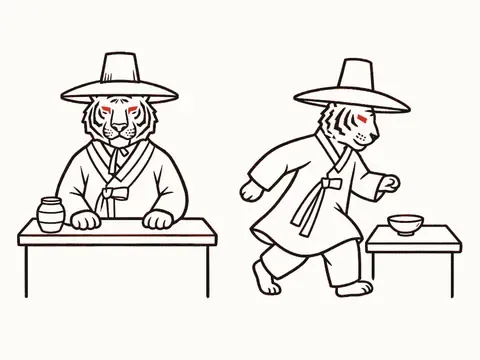
One cafe, two jobs
You and a friend are talking about the same cafe, not about a street corner. Do not start with a list. Start with the swap.
카페에 있어요.
kapee isseoyo — I am at the cafe.
에 marks the place you sit, or the place you move toward. 있다 and 가다 take this particle for location and destination.
Swap it.
카페에서 일해요.
kapeeseo ilhaeyo — I work at the cafe.
에서 marks the place the action happens. 일하다, 공부하다, 만나요, 먹어요. If you say 카페에 일해요, you hung an action on the location particle. That line is wrong.
카페에서 있어요 is the other wrong hang. 있다 is not “doing being” in the 에서 sense. You are locating a person. Use 에.
Going and leaving
Same cafe, verb 가다.
카페에 가요 — you are heading there. 카페에서 가요 — you are leaving from there. People send the second when they meant the first, and the friend waits in the wrong direction.
집에서 카페에 가요 keeps both jobs in one sentence. 에서 is the start. 에 is the end. If you reverse them — 집에 카페에서 가요 — the path collapses.
Street left and right stay on asking the way. This page does not walk a block. It only changes the particle on one building.
School as a test
학교에 있어요 — you are on campus. 학교에서 공부해요 — the studying happens there. 학교에 가요 — you are on your way. 학교에서 가요 — you are leaving school.
The wrong choice to remember: 학교에 공부해요 when you mean you study there. Students write it because they learned 에 first and then reuse it on every verb. 공부하다 is an action. It wants 에서.
Do not end on both are fine. 있다 and 가다-toward take 에. Actions, and 가다-from, take 에서. The cafe does not change. The particle tells the friend whether you are sitting, working, arriving, or already walking out. If you only remember one failed line, remember 카페에서 가요 sent to a person who is waiting for you to arrive.
Common questions
Is this the street-directions page?
No. [Asking the way](/posts/korean-asking-the-way/) uses 에 and 에서 on a pavement with 왼쪽. This page stays in one building and swaps only the particle.
Time 에?
세 시에 만나요 is time 에, a different lesson. Do not drag 에서 onto a clock. 세 시에서 만나요 is not how you set an hour.
학교에 도착했어요?
도착하다 still takes 에. You arrive at a place; you do not 'do arriving' as a scene the way 에서 wants. 학교에서 도착했어요 sounds like the school was the workplace of the arriving.
Can both appear in one sentence?
Yes. 집에서 카페에 가요. 에서 is where you leave. 에 is where you go. That sentence is the whole contrast in one line.



Practice & questions
Try a sentence with an expression from this lesson, or ask about anything you are still unsure of.
Guest comments appear after review. Existing member comments remain attached to their accounts.