
How Korean Companies Apologize: Hidden Subjects and -도록
Company Korean hides the actor, names the harm with -아서, and closes with -도록 하겠습니다. Learn to read the form, not to copy a real letter.
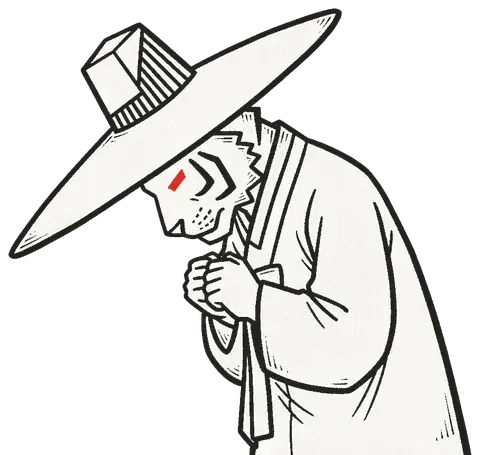
A Korean company apology is a small set of formal moves. The people who caused the problem often never appear as the subject. The harm is named, then a prevention line closes the page.
This is a reading lesson. Do not paste a real letter into your own Korean.
One real case, then the shapes
On 15 October 2022 a fire at the SK C&C data centre in Pangyo took KakaoTalk and other Kakao services offline. On 19 October, at a press conference in Pangyo, co-CEO Namgung Hun apologised to users and resigned. Hong Euntaek remained. Reporting from Yonhap and the BBC records the resignation and the promise to work so the same failure would not be repeated. A Korean business daily published the statement in full — use that page as a source, not as text to reuse.
The facts are public. The sentences below are invented shells in the same register.
Name the harm with -아서
Sorry and thanks take -아서/어서. They do not take -니까.
이용자 여러분께 불편을 드려서 죄송합니다.
iyongja yeoreobunkke bulpyeoneul deuryeoseo joesonghamnida.
We are sorry for the inconvenience caused to users.
- 드려서 — 드리다 + -어서. The harm is stated as a fact, then the apology follows.
- 죄송합니다 — the close. Formal, not 해요체.
A friend gets 정말 미안해요. A notice gets this pair: harm + 죄송합니다.
Put the matter on record: 바, then 점
Institutional Korean likes a bound noun that turns a clause into “the matter we are treating as recorded.”
앞서 안내드린 바 있습니다.
We have already informed you of this (on record).
That is -은 바 있다: experience or a prior statement placed on the formal record. Café Korean would say 안내한 적 있어요. The notice wants 바.
A cousin you will also see, without its own grammar slot, is 점:
안내가 늦어진 점 사과드립니다.
We apologise for the late notice.
점 is an ordinary noun: a point, an aspect. 늦어진 점 packages the fault as a thing the sentence can bow to. Learners pause on 바 and 점 for the same reason — both hide a full clause inside a noun.
Hide the actor
Compare two invented lines:
저희가 점검을 늦게 시작했습니다.
We started the check late.
서비스가 일시 중단되었습니다.
The service was temporarily suspended.
The second is the house style. The service is the subject. Who delayed the check is off stage. Korean does this with 되다 after a hanja noun (중단되다, 확인되다) and with passives such as 알려지다. There is no separate “passive” id on this site for 이/히/리/기; learn the move from the sentence: event up, people down.
A press conference still has human bodies bowing. The written notice often does not keep those bodies as grammar subjects.
Close with prevention
같은 일이 다시 일어나지 않도록 하겠습니다.
We will see to it that the same thing does not happen again.
-도록 aims at a result: so that it does not happen. -겠- then marks present resolve, not a weather forecast and not a café 할게요. The pair is the standard last move: prevention as a promise.
You will also meet 재발하지 않도록, 재발 방지를 위해 노력하겠습니다. Same job. Different nouns.
What not to steal
Do not lift Kakao’s wording. Do not invent a fake scandal to practise. If you need to apologise as a person, stay human: 늦어서 미안해요. If you need to read a bank, a ministry, or a platform notice, hunt four things in order:
- What was harmed (…어서 죄송합니다).
- What is on record (바 / 점).
- Whether a human subject is named.
- What they claim will not happen again (않도록 하겠습니다).
That sorting is the whole lesson.
Common questions
Can I paste this register into a text to a friend?
No. 바입니다 and 않도록 하겠습니다 sound like a notice board. To a friend, 미안해 or 정말 미안해요 is the human sentence. Keep the company forms for reading press conferences and customer mail.
Is 확인한 바입니다 the same as 확인한 적 있어요?
Same bound-noun family, different seat. 적 is café experience. 바 puts the content on formal record — speeches, notices, careful statements.
Do I need to quote a real apology to learn this?
No. The shapes repeat. Read one real case for the situation, then practise on invented shells so you are not copying anyone's letter.
Why is the subject missing so often?
Institutional Korean often lets the event or the service be the topic. 저희가 admits an actor. Many notices would rather not.
Sources
Written as educational material for Korean learners. Sources for the facts are below:
Practice & questions
Try a sentence with an expression from this lesson, or ask about anything you are still unsure of.
Guest comments appear after review. Existing member comments remain attached to their accounts.