
Sageuk Speech: Hear It, Don't Wear It
Court honorifics in sageuk sit close to the documents. Everyday Joseon talk was barely recorded, so the shows keep a costume. Hear it, and leave it there.
The line you can pin down
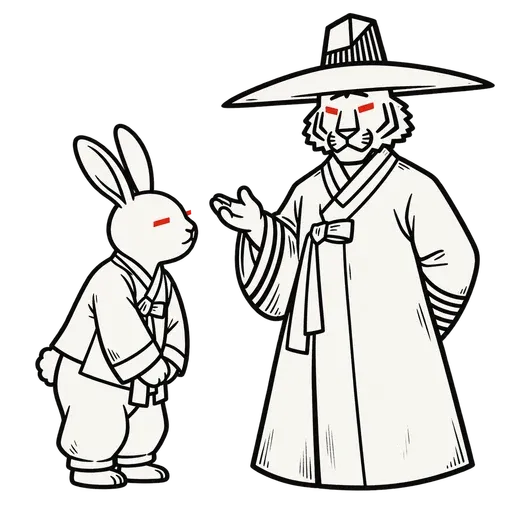
In Queen Seondeok (선덕여왕), the hwarang greet the princess with a sentence the writer later printed, in Alcheon’s name.
비천지도의 화랑 알천, 화랑의 주인 공주님을 뵈옵니다.
Park Sang-yeon gave that wording in a GQ Korea interview on 2 October 2014. Rank, a lowered name, then 뵈옵니다. 뵙다 is the humble “see” you still have. -옵- lowers the speaker. -니다 is the formal ending inside 합니다.
How the sentence ends
하오체 raises the listener more than familiar talk, and less than 합니다. The shape is -으오 after a consonant and -오 after a vowel: 먹으오, 가오. -소 belongs after a consonant: 있소. Do not glue -소 onto a vowel. -구려 marks a fact you have just noticed: 날이 차구려.
Above that is the extreme humble toward a king. 아뢰옵니다 is 아뢰다, “I report this upward.” -사옵니다 puts a humble -사오- inside an old formal statement: 준비되었사옵니다. The dictionary still lists it as literary, for the 하십시오 seat.
The next endings talk at the room, not to a rank. -느니라 teaches something as the way things are: 물은 아래로 흐르느니라. -도다 is that plain seat, solemn and exclaiming: 달이 밝도다. 왔렷다 is the crier’s shape the shows love. A search of the standard dictionary did not return -렷다 as its own headword, so do not build a rule on it.
What they call you
전하 is the Joseon honorific for the king. 상감 is the dictionary’s raised word for the king, and the shows stretch it to 상감마마. 대감 is what the shows call a high official. 나리 raises someone with standing or power. 자네 and 그대 address a friend or someone below you. Warmer than 너. Not 당신.
What they call themselves
과인 is the king lowering himself, “a person of little virtue.” 짐 is also a king’s “I” in the dictionary. This page will not say which centuries used which. 소신 is a minister lowering himself before the king. 소인 is a lower person lowering himself toward anyone above.
How much of this is real
Court formula has a paper trail. Everyday Joseon talk mostly does not.
An SBS report on 10 October 2015 asked Ahn Dae-hoe, a classical-Chinese scholar at Sungkyunkwan University, whether palace speech and common speech really differed. He said he had not seen evidence that they did. A difference is a guess. A king, he thought, would have used more learned words, not a separate language. The same report says the extreme honorific toward the king does match what was used — 전하, 통촉하여 주시옵소서 — and that it matches today’s sageuk. A king’s private letters in that report still sound like Korean you know, including 눈코 뜰 새 없다. Research on how people spoke is thin next to research on grammar, so courtyard dialogue is where a broadcast convention takes over.
The Alcheon line shows the limit. The writer says he built that greeting from European medieval chivalric records, turned into literary Korean. Sageuk speech had mostly been made for Joseon, so for Silla he wanted a voice of his own. That is the story of one greeting. Court endings toward a king still sit with the documents. Dinner talk does not.
What you do with it
Hear the rank. Do not answer in it. Tell a late friend 늦었사옵니다 and you have walked into a play. Living Korean still has 해요체 for most of life and 합니다체 when the room is formal. 하오체 is real grammar. It is no longer how you order coffee.
Sources
Written as educational material for Korean learners. Sources for the facts are below:
Practice & questions
Try a sentence with an expression from this lesson, or ask about anything you are still unsure of.
Guest comments appear after review. Existing member comments remain attached to their accounts.