
Why Hangeul Day Is Special in 2026: Hangeul vs. Korean
Korean is a language; Hangeul is its writing system. Learn the difference, why October 9 is Hangeul Day, and why the 2026 holiday marks 100 years.
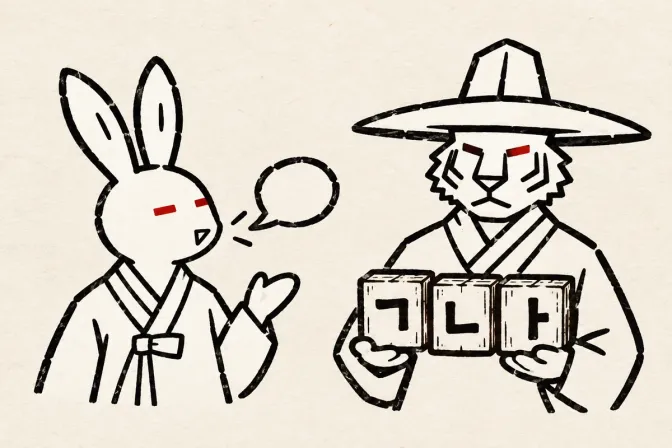
“I am studying Hangeul.” Is that the same as “I am studying Korean”?
Sometimes—but not always. If you are learning the consonants and vowels, 한글을 공부해요 makes sense. If you are learning conversation, grammar, listening, and vocabulary, 한국어를 공부해요 is more precise.
Korean is a language. Hangeul is the writing system used to write it. The two belong together, but they are not the same thing.
Korean and Hangeul do different jobs
| Korean | What it means | Example |
|---|---|---|
| 한국어 | the Korean language | 한국어로 말해요. I speak in Korean. |
| 한글 | the Korean writing system | 한글을 읽어요. I read Hangeul. |
| 한글날 | Hangeul Day, October 9 | 한글날에는 학교와 회사가 쉬어요. Schools and offices close on Hangeul Day. |
Compare these sentences:
- 저는 한국어를 배워요. — I am learning Korean.
- 이제 한글을 읽을 수 있어요. — I can read Hangeul now.
- 한국어 단어를 한글로 써요. — I write Korean words in Hangeul.
In the last sentence, 한글로 uses (으)로 to mark the means or system used. You can write 영어로 (in English), 한글로 (in Hangeul), or 연필로 (with a pencil).
King Sejong did not invent Korean
Korean was spoken long before Hangeul existed. Korean writing, however, relied mainly on Chinese characters. Those characters were difficult to learn and did not fit every Korean sound neatly.
King Sejong created a new script so that ordinary people could record their own words more easily. The accurate sentence is:
세종대왕이 한글을 만들었어요.
King Sejong created Hangeul.
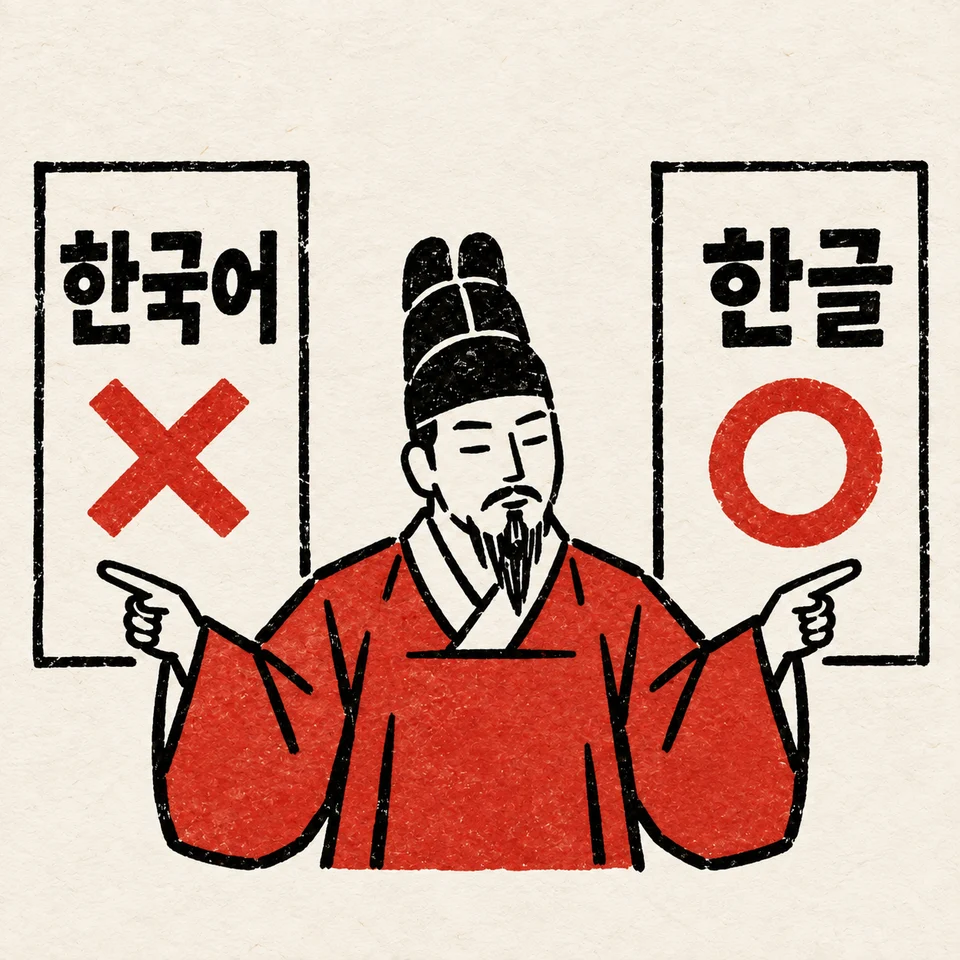
Do not say that King Sejong created the Korean language. He created a writing system for a language people already spoke.
What is Hunminjeongeum?
The script’s first name was 훈민정음 (Hunminjeongeum), usually understood as “the correct sounds for instructing the people.”
The name can refer to two related things:
- the new script created under King Sejong
- the book that explained its design and use
The script was created in 1443. The explanatory book was published in 1446. Today, 한글 is the everyday name of the script, while 훈민정음 appears when discussing its original name or the historical book.
Why is Hangeul Day on October 9?
Hangeul Day commemorates the promulgation of Hunminjeongeum. The surviving record gives a period rather than one exact modern calendar date. Scholars used that record to establish October 9 as the anniversary.
Hangeul Day is now a Korean national holiday. Article 20 of the Framework Act on the Korean Language formally designates October 9 and calls for annual commemorative events.
Why 2026 is special
In 1926, the Korean Language Research Society held an organized celebration of the promulgation of Hunminjeongeum. That observance grew into today’s Hangeul Day.
Its first name was 가갸날 (Gagyanal). Learners used to recite combinations such as 가갸거겨 while learning the script, so 가갸 became a familiar shorthand for the alphabet. The celebration adopted the name 한글날 in 1928.
The year 2026 marks 100 years since the first Gagyanal and 580 years since the promulgation of Hunminjeongeum in 1446. It does not mean that Hangeul is 100 years old. It means Koreans have held an organized day celebrating it for a century.
Remember it in one line
한국어 is the language you learn; 한글 is the script you use to write it.
Say 한국어를 공부해요 when you mean Korean as a whole. Say 한글을 공부해요 when you specifically mean learning the letters or practicing reading and writing.
For Hangeul Day, choose one Korean sentence you like and write it slowly in Hangeul. You will see the language and its writing system meet on the page.
Common questions
Is ‘한글을 공부해요’ wrong?
Not always. It is natural when you mean learning the consonants and vowels or practicing reading and writing. If you mean conversation, listening, vocabulary, and grammar as a whole, 한국어를 공부해요 is more precise.
Did King Sejong invent the Korean language?
No. People spoke Korean before Hangeul was created. King Sejong created a writing system that made Korean much easier to record.
Are Hunminjeongeum and Hangeul the same thing?
They can refer to the same script. Hunminjeongeum was its original name; Hangeul is the modern name. Hunminjeongeum is also the title of the book that explains how the script works.
Why was the first celebration called Gagyanal?
Learners once practiced the script by reciting combinations such as 가갸거겨. The celebration was therefore named 가갸날. The name 한글날 came into use in 1928.
Sources
Written as educational material for Korean learners. Sources for the facts are below:
Practice & questions
Try a sentence with an expression from this lesson, or ask about anything you are still unsure of.
Guest comments appear after review. Existing member comments remain attached to their accounts.